
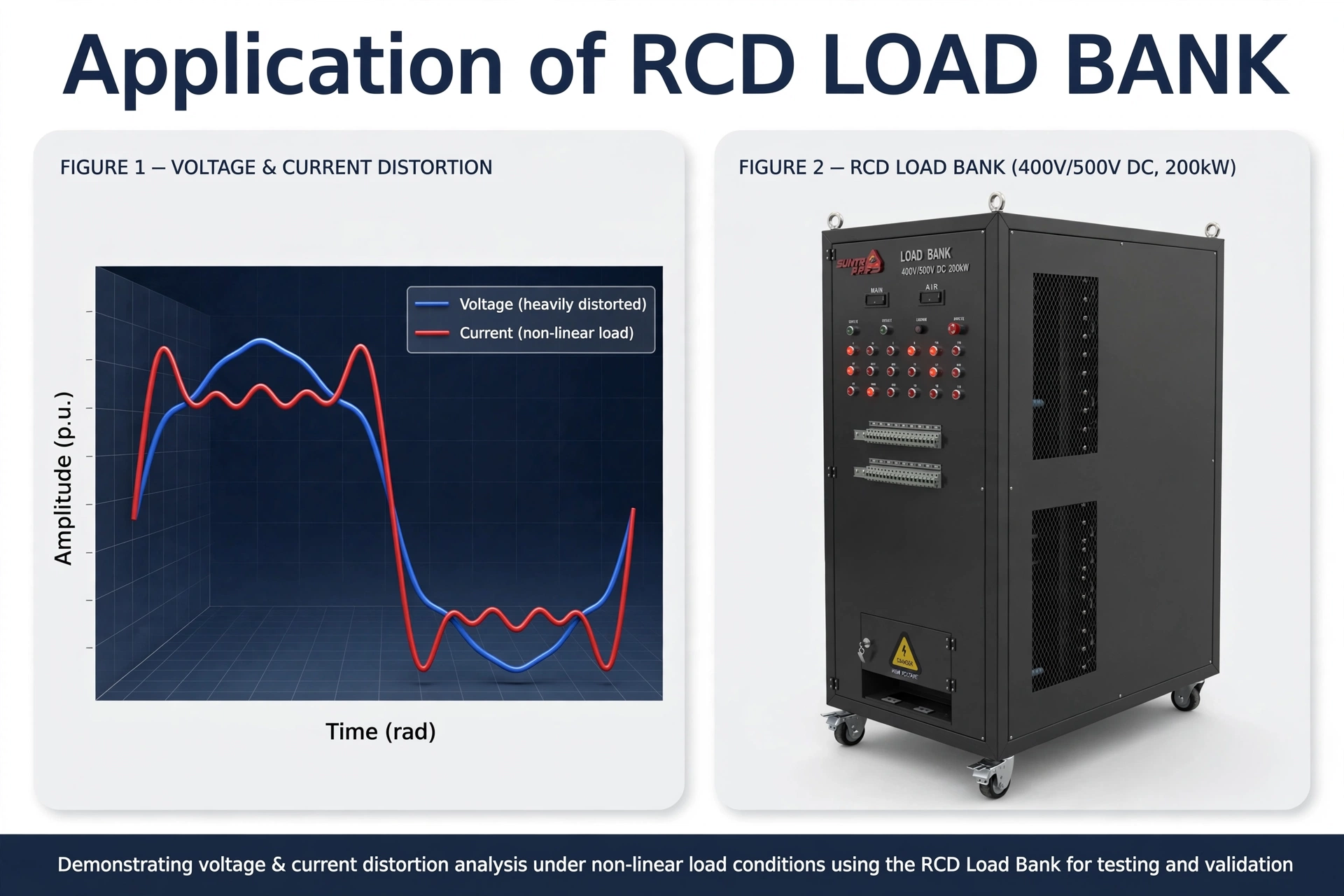
Application of RCD vs RLC Load Banks for Testing Generators and UPS Systems:
The difference between RCD and RLC load banks is quite significant when testing generators or UPS systems, because each type imposes a different electrical characteristic on the system under test. Here’s a detailed comparison to help you choose the right one for your application:
1. RCD Load Bank
RCD = Resistive + Capacitive + Diode/Rectifier (or DC load)
(In some manufacturer contexts, RCD is shorthand for Resistive + Capacitive + Dynamic load, but in most UPS/generator testing, it implies a non-linear or rectified load.)
Characteristics:
· Simulates non-linear loads, such as those produced by rectifiers, inverters, and modern data center equipment (computers, UPS input stages, LED drivers, etc.).
· Draws current with harmonics, typically THDi between 25%–50%, similar to real-world IT or data center loads.
· Provides a realistic way to test how a UPS or generator handles harmonic currents, crest factor, and waveform distortion.
Use Case:
· UPS testing (especially double conversion systems) to verify performance under distorted load.
· Generator tests when evaluating AVR and governor stability with non-linear loads.
Pros:
· Simulates real-world power electronics loads.
· Evaluates true dynamic performance of the UPS inverter or generator AVR.
· Identifies harmonic handling and waveform distortion issues.
Cons:
· More expensive than purely resistive or RLC banks.
· Generates harmonics that can stress the test system.
· Power factor and current waveform are not adjustable independently.
2. RLC Load Bank
RLC = Resistive + Inductive + Capacitive
Characteristics:
· Provides linear loads with adjustable power factor (lagging, leading, or unity).
· Simulates loads such as motors, transformers, fluorescent lighting, and capacitor banks.
· Typically has sinusoidal current with negligible harmonic distortion.
Use Case:
· Generator load testing to check voltage regulation, stability, and power factor performance.
· UPS testing (for design verification) under different power factors without harmonics.
Pros:
· Adjustable power factor for comprehensive testing.
· No harmonic distortion (clean sinusoidal current).
· Useful for verifying true kVA capacity and reactive performance.
Cons:
· Does not simulate non-linear loads typical of modern data centers.
· Less representative of real-world IT or UPS loads.
Summary Table
Feature RCD Load Bank RLC Load Bank
Type of load Non-linear (rectifier type) Linear
Harmonics High Negligible
Power factor Fixed, depends on load design Adjustable (0.8 lag to 0.8 lead typical)
Realism for UPS High (simulates IT loads) Moderate
Realism for Generator High for modern loads High for conventional loads
Cost Higher Moderate
Typical Application UPS factory/field test, data centers Generator acceptance, reactive power tests
Recommendation
· For UPS testing, especially data center UPS systems, use RCD load banks to simulate realistic non-linear loads.
· For generator testing, especially when verifying AVR and governor stability at different power factors, use RLC load banks.
· For comprehensive system validation, many test facilities use combined RLC + RCD load banks that can switch between linear and non-linear modes.
.png)


