
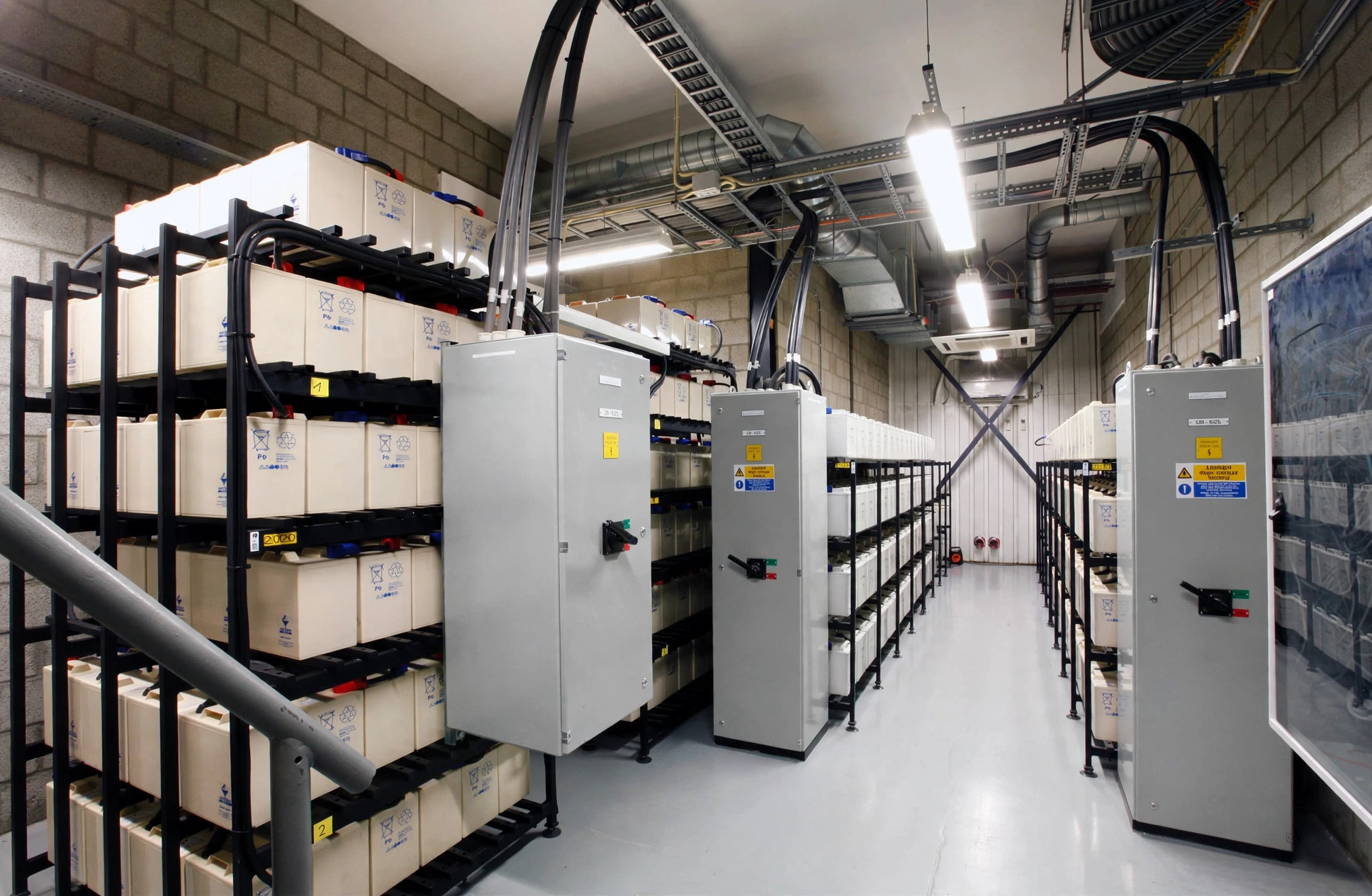
In a parallel UPS system, battery architecture plays a huge role in reliability, maintenance, fault tolerance, and lifecycle cost.
There are two main configurations:
1. Common Battery Bank
2. Distributed (Per-UPS) Battery Banks
Let’s break them down technically and visually.
1- Common Battery Bank (Shared Battery System)
What It Is
Multiple UPS modules are connected in parallel, but all of them share one large centralized battery bank.
How It Works
· UPS modules share the load.
· All UPS units draw DC power from the same battery string during outage.
· One battery charger (or multiple tied chargers) feeds the same bank.
Advantages
· Lower initial battery cost
· Easier battery monitoring (single system)
· Less floor space for batteries
· Simpler installation
Disadvantages
· Single point of failure (battery bank failure affects all UPS units)
· Ripple voltage on the DC bus may increase as a result of cumulative contributions from parallel UPS modules.
· Maintenance requires careful planning and Maintenance Constraints
· Fault in DC bus can impact entire system
· Charger Interaction & Circulating Effects by each individual UPS system to the next unit
· DC float and boost Voltage regulation conflicts
· More complex coordination
· Harder to isolate battery issues per module
Best Used For:
· Cost-sensitive installations
· Systems where redundancy is at UPS level only (not battery level)
· Non–mission-critical loads
2- Distributed Battery Banks (Each UPS Has Its Own Battery)
What It Is
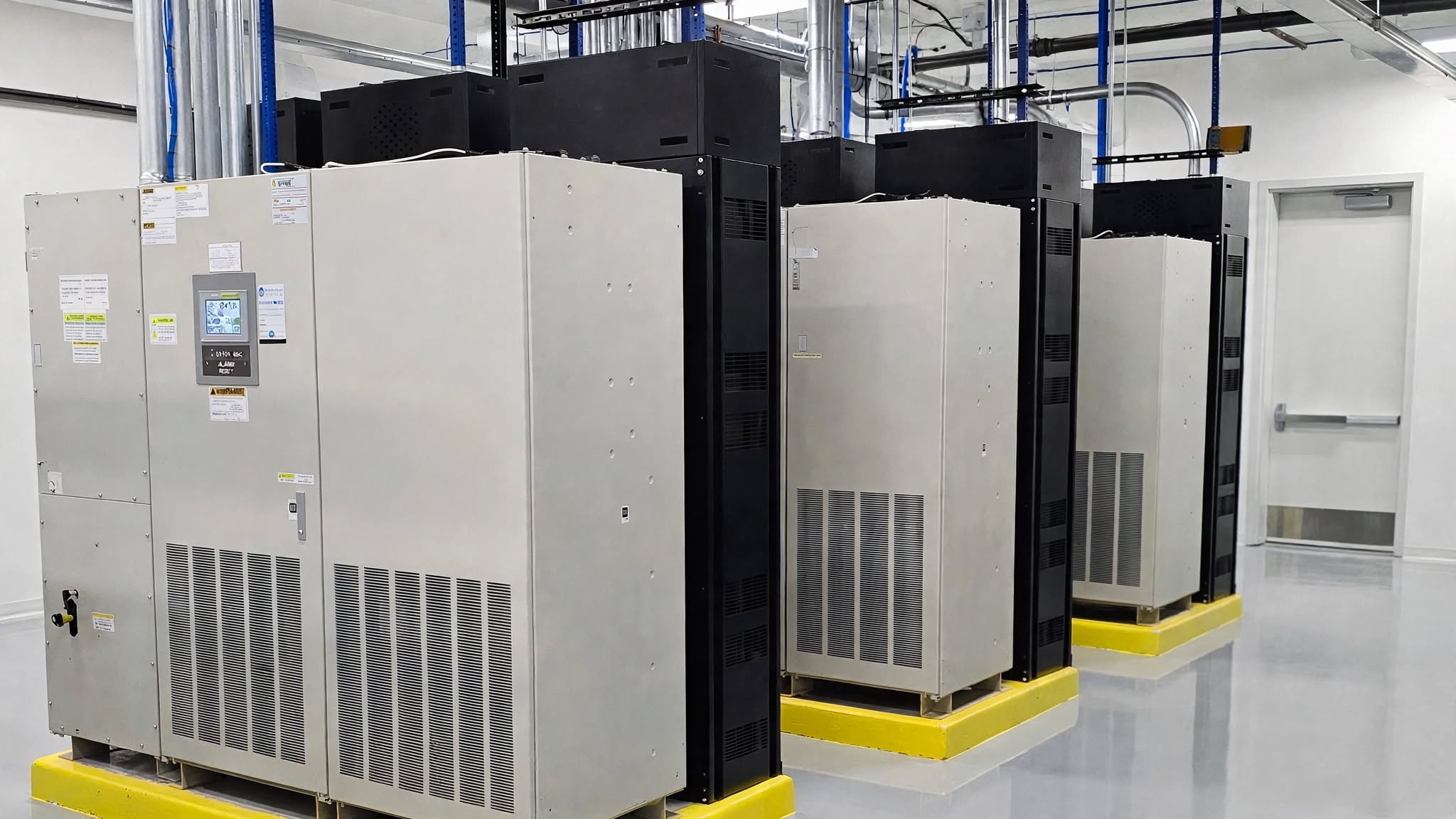
Each UPS module has its own dedicated battery bank.
If you have 3 UPS modules → you have 3 independent battery systems.
How It Works
· UPS modules share AC load
· Each UPS draws from its own battery during outage
· Batteries are isolated from each other
Advantages
· No single battery failure point
· Higher system redundancy
· Better fault isolation
· Maintenance can be performed per module
· Higher availability for Tier III/IV data centers
Disadvantages
· Higher initial cost
· More space required
· More complex monitoring
· Potential unequal battery aging
Best Used For:
· Data centers
· Hospitals
· Mission-critical industrial loads
· Systems requiring high availability (N+1, 2N)
Technical Comparison
Feature Common Battery Distributed Batteries
Redundancy UPS-level only UPS + Battery-level
DC Fault Risk High impact Isolated
Cost Lower Higher
Reliability Moderate High
Maintenance Flexibility Limited High
Scalability Moderate High
Power Quality & Load Sharing Impact
In parallel systems:
· With common battery, if battery impedance increases, it affects all UPS modules equally.
· With distributed batteries, impedance mismatch can cause unequal discharge currents unless properly synchronized.
This becomes critical in:
· Active load sharing control
· Battery string impedance variation
· DC bus protection coordination
· Failure mode analysis in ETAP modeling
Real-World Design Trend
Modern modular UPS systems (especially lithium-ion based systems) increasingly favor:
Distributed battery architecture for Tier III / Tier IV facilities
Because availability > cost in mission-critical environments.
Engineering Perspective (Design Decision Rule)
If your load classification is:
· Office / Commercial → Common battery acceptable
· Industrial critical process → Depends on risk tolerance
· Data center / Healthcare → Distributed strongly recommended
Conclusion:
If the goal is:
· Cost optimization → Common battery
· Maximum availability & fault tolerance → Distributed batteries
In modern mission-critical design (especially modular UPS systems), distributed battery architecture is increasingly preferred despite higher CAPEX because it dramatically reduces systemic failure risk.
.png)


