
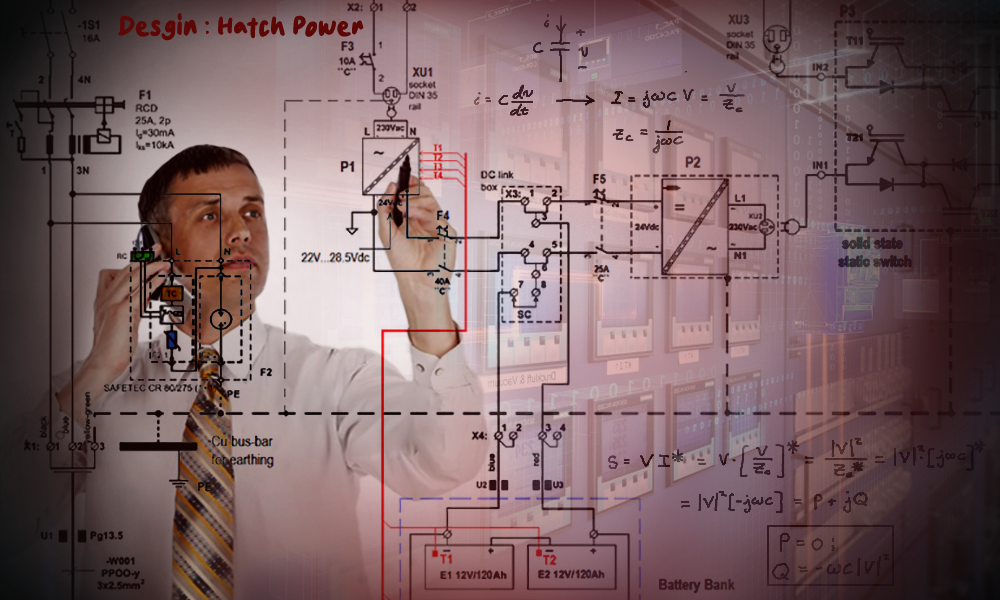
To maximize reliable power for critical loads in a UPS (Uninterruptible Power Supply) design, you need to follow structured strategies across system architecture, component selection, redundancy, and maintenance. Here are the key UPS design strategies to ensure maximum reliability:
1. Load Analysis & Sizing
· Identify Critical Loads: Clearly define what constitutes a critical load (e.g., data centers, hospital equipment, control systems).
· Proper Sizing: UPS should be sized for the full load capacity with headroom (typically 20-30%) to handle growth or transient conditions.
2. Topology Selection
· Choose the right UPS topology:
o Double Conversion (Online): Best for high-reliability and sensitive equipment.
o Delta Conversion: Offers energy savings and reliability.
o For modern IT environments with space, weight, and energy concerns → go with High-Frequency UPS.
o For older facilities, industrial settings, or where electrical noise/isolation/fault handling** are critical → use Low-Frequency UPS.
· Select between:
o Transformer-based: For better fault isolation and industrial environments.
o Transformer-less: For efficiency and compactness in clean environments.
3. Redundancy & Scalability
· N+1 or 2N Redundancy:
o N+1: One additional unit for redundancy.
o 2N: Full duplication of the UPS system for highest reliability.
· Modular UPS: Easily scalable with hot-swappable modules; ideal for phased growth and uptime.
4. Centralized vs Decentralized Architecture
· Centralized:
o One large UPS system supporting multiple loads.
o Easier to monitor but may create a single point of failure.
· Decentralized (Distributed):
o Multiple smaller UPS systems closer to each load.
o Increases redundancy and isolates faults.
5. Static Transfer Switches (STS)
· Use dual STS between separate UPS systems for split load configurations. It enables seamless transfer between redundant UPS sources without interruption.
6. Bypass Pathways
· Maintenance Bypass Switch (MBS): Enables servicing of the UPS without powering down the load.
· Ensure automatic and manual bypass options for flexibility.
7. Battery System Design
· Use high-quality batteries (VRLA, Lithium-ion, or Nickel-Zinc Batteries) suitable for your environment.
· Design for sufficient runtime (typically 5–15 minutes) to allow generator startup or safe shutdown.
· Include battery monitoring systems and ensure temperature control.
8. Environmental Control
· Ensure UPS and battery rooms are climate-controlled to extend life and maintain performance.
· Use proper ventilation and dust control.
9. Monitoring & Alarming
· Integrate with Building Management System (BMS) or Data Center Infrastructure Management (DCIM).
· Real-time monitoring of:
o Input/output voltage
o Battery status
o Load level
o Alarms & event logs
10. Preventive Maintenance & Testing
· Schedule regular preventive maintenance by certified OEM technicians.
· Perform load testing, thermal imaging, and battery discharge tests periodically.
· Maintain spare parts inventory for quick repair turnaround.
11. Power Path Selectivity
· Coordinate circuit protection devices (breakers/fuses) to ensure that only the faulted branch is disconnected during a fault.
· Avoid cascading failures that affect multiple loads.
12. Generator Integration
· Ensure UPS-to-generator compatibility, including frequency and voltage stabilization.
· Use automatic transfer switches (ATS) with proper delay settings to avoid unnecessary transfers.
13. Compliance and Standards
· IEEE 446 – Emergency and Standby Power
· NFPA 70 (NEC) – Articles 645, 700, 701
· IEC 62040 – UPS General and Performance
· UL 1778 – UPS Safety
· CSA C22.2 No. 107.3 – UPS in Canada
Conclusion:
UPS reliability depends on correct load sizing, choosing the right topology, and applying redundancy (N+1 or 2N).
System design should include proper battery backup, bypass paths, and generator integration for continuity.
Environmental control and modular or distributed architecture improve uptime and fault isolation.
Continuous monitoring, maintenance, and compliance with standards ensure long-term safe operation.
.png)


