
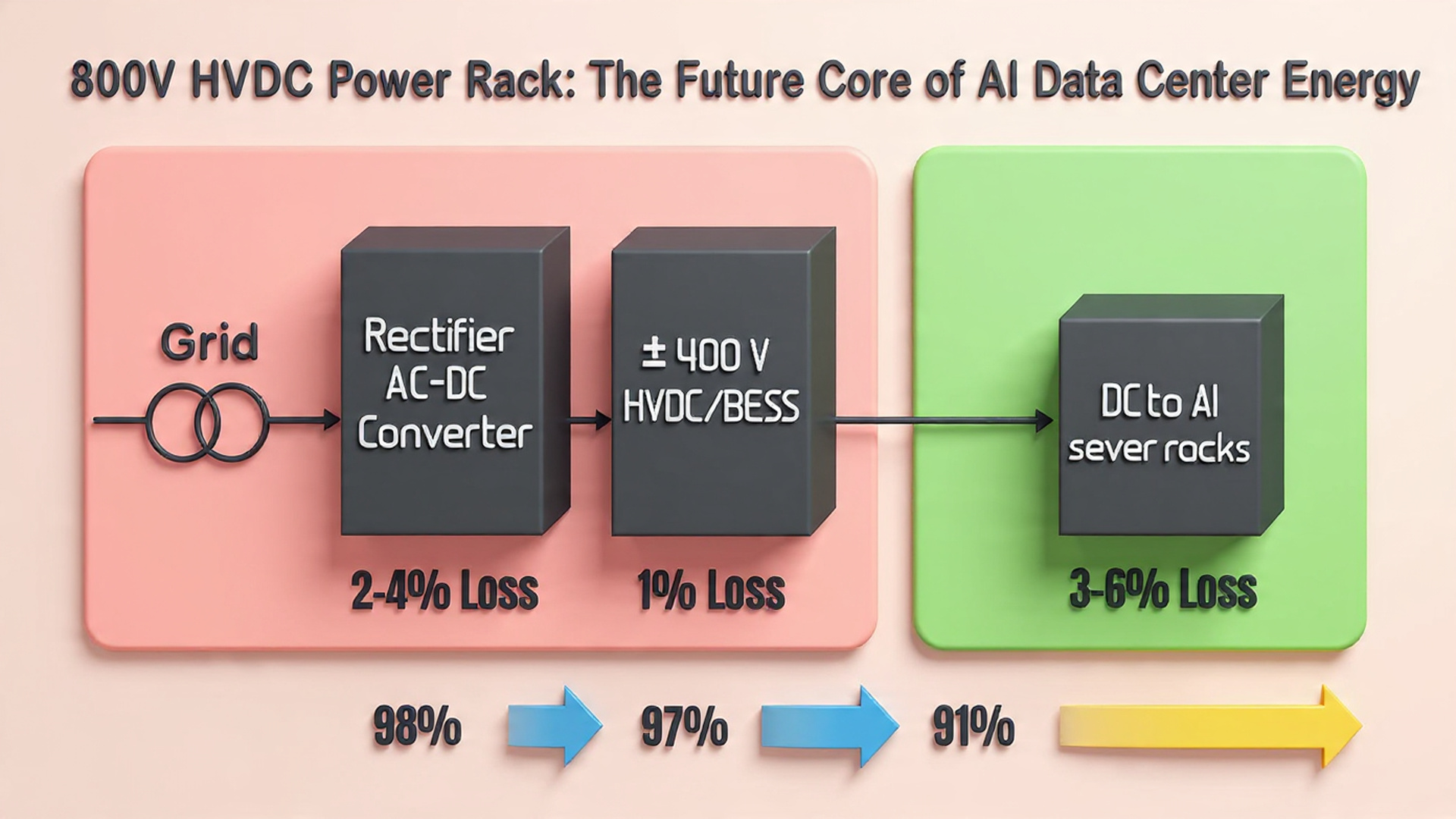
An ±400V HVDC Power Rack is a modern power delivery and backup system designed to supply high-voltage direct current (HVDC) power at ±400 volts (meaning +400V and -400V relative to ground) directly to servers and IT equipment in AI data centers. This architecture replaces traditional alternating current (AC) power distribution systems and conventional uninterruptible power supplies (UPS), delivering higher efficiency, scalability, and performance to meet the demanding power requirements of AI workloads.
__________________________________________________________________________________
1. Understanding ±400V HVDC:
· HVDC (High-Voltage Direct Current): Instead of using AC (Alternating Current), the system uses DC (Direct Current) at high voltage levels to power servers.
· ±400V Bipolar DC Bus: The system has two voltage lines—one positive (+400V) and one negative (-400V)—with respect to a common ground, creating an 800V voltage difference. This bipolar configuration enhances system stability, safety, and reduces electromagnetic interference.
__________________________________________________________________________________
2. Why ±400V HVDC for AI Data Centers?
AI Data Center Power Needs:
· AI servers, especially those with GPUs or AI accelerators, require very high power density, often between 30 kW to over 100 kW per rack.
· Traditional AC power distribution struggles to efficiently supply such high power without excessive losses, large cables, bulky UPS systems, and complex cooling requirements.
Advantages of ±400V HVDC:
.png)
__________________________________________________________________________________
3. Typical Architecture of ±400V HVDC Power Rack System:
1. Grid or Renewable Source (AC Input): Incoming AC power from utility or on-site renewable generation.
2. Front-End Rectifier and Battery Energy Storage System (BESS): Converts AC to ±400V DC and charges batteries directly at the DC bus voltage.
3. ±400V HVDC Bus: The backbone DC power distribution bus feeding multiple racks.
4. Power Rack Unit: Modular power distribution units mounted in server racks that deliver ±400V DC directly to servers.
5. AI Servers with DC-DC Converters: Servers equipped with power supplies or DC-DC converters optimized to accept ±400V DC input, powering CPUs, GPUs, and other components.
__________________________________________________________________________________
4. How ±400V HVDC Power Rack Supports AI Workloads:
· High Power Density: Supports racks consuming tens of kilowatts without oversized cables or bulky AC UPS units.
· Lower Latency in Power Delivery: Direct DC supply means less delay and fewer points of failure.
· Simplifies Integration with Battery and Renewable Energy: Easier to incorporate lithium-ion battery packs or solar power with DC output.
· Optimizes Total Cost of Ownership (TCO): Reduces capital expenditures on power infrastructure and operational expenses for cooling and maintenance.
· Future-Proofing: As AI workloads increase in complexity and scale, ±400V HVDC infrastructure is better positioned to meet evolving needs.
__________________________________________________________________________________
5. Industry Trends & Real-World Examples:
· Large hyperscale cloud providers and AI-focused companies are investing heavily in HVDC power systems for their AI clusters.
· Vendors like Huawei, Vertiv, Delta Electronics, and the Open Compute Project (OCP) are developing or standardizing ±400V HVDC power racks.
· These systems are often deployed in AI supercomputing centers, hyperscale data centers, and edge AI facilities to enable dense GPU deployments.
__________________________________________________________________________________
6. Summary:
.png)
✅ Summary Table:
.png)
.png)


